
There are - depending on the chosen taxonomy and the time when you use it - roughly around 400 species and subspecies of parrots (Psittaciformes). Each eternal species has something unique to offer, be it a beautifully colored plumage, an exciting behavior, or whatever it is that fascinates the individual aviculturist. However, most aviculturists do not have infinite resources and financial means, so as an aviculturist you must try to practice the "art of limitation". After for many years primarily having had a “generalist bird collection” (i.e., a single pair of many different parrot species), in 2017, in connection with the move to a country side house, I chose to change my bird collection to a “specialist bird collection”. This collection only includes about 10 species/subspecies, but in return I aim to have 3 - 4 pairs of each species, and in a single case many pairs of a single species. The conversion to a “specialist bird collection” entails a number of advantages, i.a. you can really get to know the individual species in depth over time, since two birds of the same species do not necessarily exhibit the same behavior, and if you at the same time work targeted with species-conservation breeding of endangered species, it is also often easier to substitute a bird in the event of death.
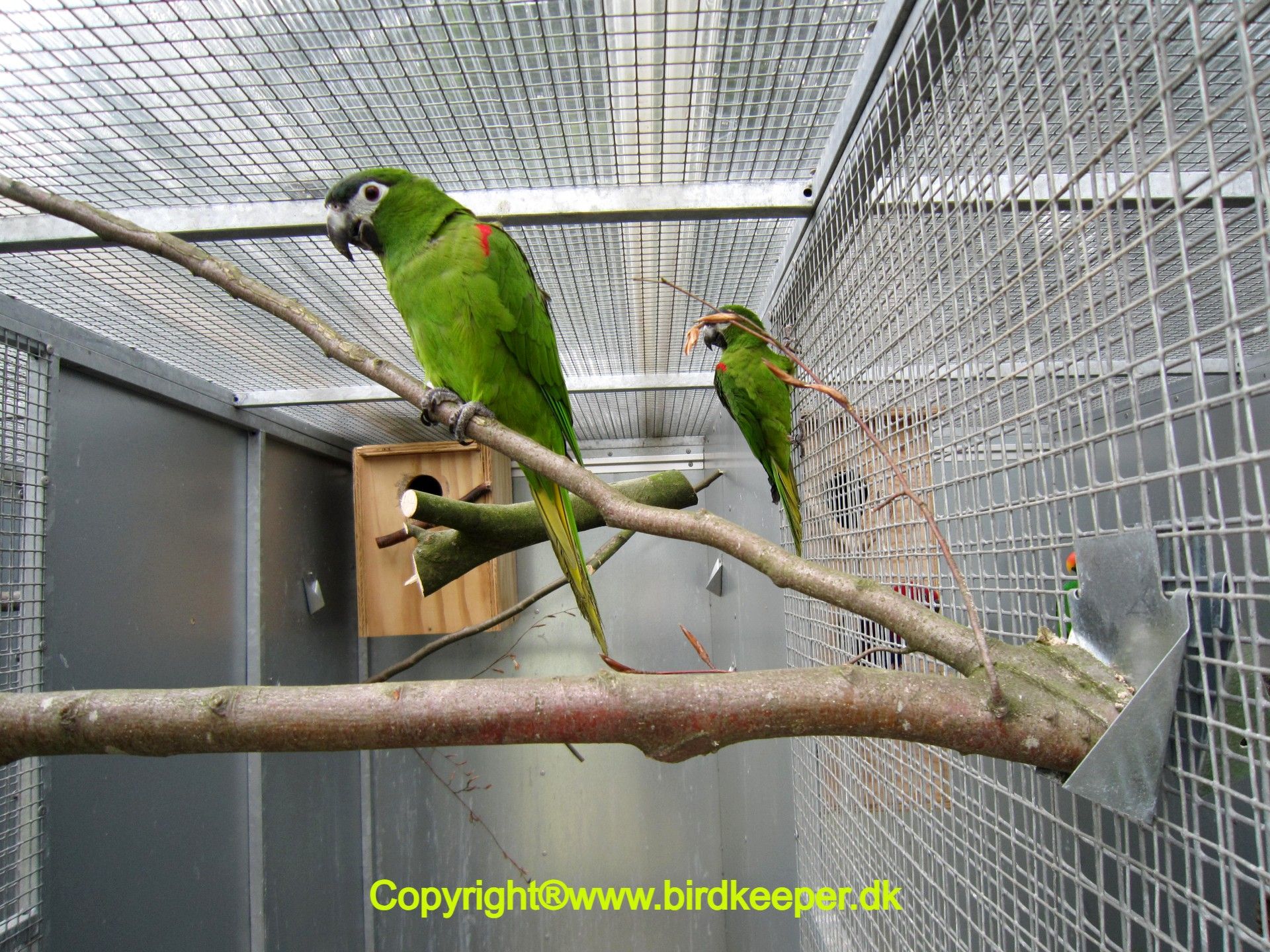
This photo collage shows one of the species that I have previously kept for many years, the lovely Red-shouldered Macaw/Hahn's Zwergara (Diopsittaca nobilis), which is the smallest Macaw, or rather “Mini-Macaw”, found. It is a very lively - and not least very noisy - bird, which, although the plumage may not be the most brightly colored, still appears to be incredibly beautiful, as its bright red bend of wings and greater under wing-coverts light up as a contrast to the predominantly deep green plumage. It is one of the species that I have unfortunately had to say goodbye to in connection with the conversion to a “specialist bird collection”, but you can't have everything in life, you just have to limit yourself if you also have a high level of ambition regarding the care and the hygiene linked to the bird keeping and breeding. When I was young, I also kept its very close relative, the Lesser Noble Macaw/Lichtenstein's Zwergara (Diopsittaca cumanensis cumanensis) - shown on the last photo below - as a domestic tame bird; it is among other things slightly larger and its upper bill is light horn colored and appears anatomically very different as it is wider and has a more rounded culmen (this species is shown in the last photo).
I can occasionally miss this sprightly - and VERY - vital parrot species, and I will remember it for many entertaining moments over the years, even if it often with for its size very powerful voice and lightning-quick movements sometimes could have a disturbing effect on the other species in the neighboring aviaries.




Best regards,
Jorgen Petersen
BIRDKEEPER PARROT BREEDING FACILITIES
“Natural breeding, natural behaviour”
© Jørgen Petersen · BIRDKEEPER PARROT BREEDING FACILITIES - All rights reserved.

